
How to Get to St. Barth by Air: SXM, Planes, Heli
Most people get the logistics of how to get to St. Barth wrong on the first try. Every arrival is two legs. First a long-haul flight to a regional hub, then a short hop in a small plane or helicopter, because no jet lands on the island itself.
This is the single fact that shapes every St. Barth arrival, and the one most first-time visitors miss when they book. The runway at Gustaf III is roughly 646 meters, about 2,119 feet. That makes it one of the shortest in regular commercial service anywhere. It runs downhill from a steep approach over a hilltop and ends at the sand of St-Jean beach. Only small STOL aircraft fly in, the kind that seat fewer than twenty people, flown by pilots who hold a special certification for this field and nowhere else quite like it. There is no jet bridge, no widebody, and no overnight red-eye. Everything about reaching Saint-Barthelemy is organized around that constraint, and once you understand it the whole trip becomes simple to plan.
What follows is how we route guests in practice, year after year, across both calm shoulder weeks and the crush of the holidays. We cover how to choose your gateway, the difference between the fixed-wing shuttle and the helicopter, how a private jet fits in, the connection chain at Sint Maarten step by step, the dusk cutoff that catches people out, baggage limits on small planes, and what changes when you travel with children, a group, or a lot of luggage. If you would rather hand the whole sequence to someone on the island, our team arranges the flights and inter-island connections end to end.
How to get to St. Barth: why no jet lands here
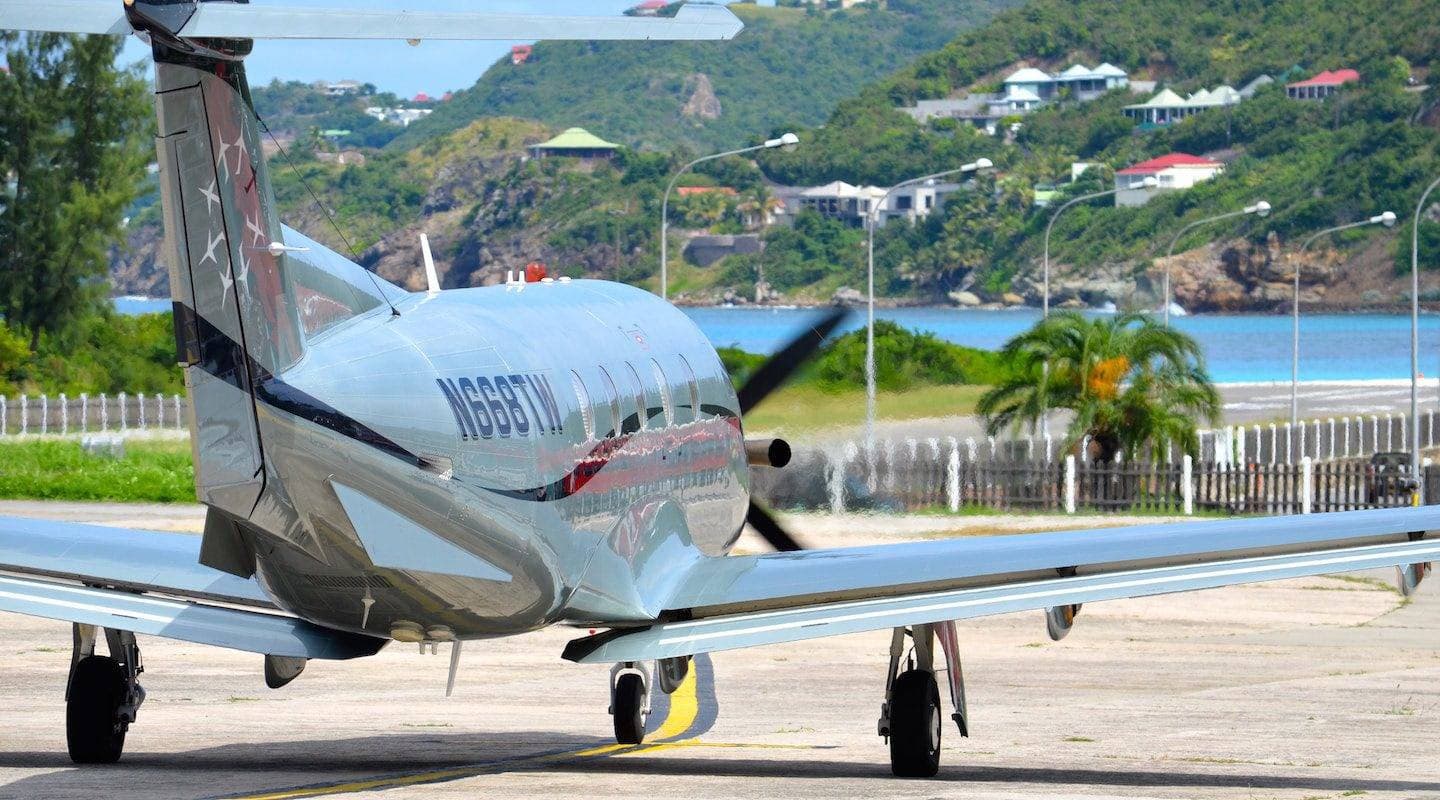
The short answer is physics. Gustaf III Airport, also called Remy de Haenen, carries the IATA code SBH and the ICAO code TFFJ. Its runway is about 646 meters, near 2,119 feet, with a field elevation around 48 feet. A commercial jet needs several times that length to land and stop, and far more to take off again with a useful load. So the largest aircraft you will see here in regular service is a nineteen-seat de Havilland DHC-6 Twin Otter. Below that sit the Cessna 208B Grand Caravan, the Britten-Norman BN-2 Islander, and the single-engine turboprop Pilatus PC-12.
The approach adds to the challenge. Aircraft come in over the Col de la Tourmente, a hill at the threshold of runway 10. The hilltop was actually lowered between 2003 and 2005 to ease the descent angle, and even so the approach is steep by any standard. Once over the rise, the aircraft drops quickly to the numbers, rolls downhill, and the runway ends where the sand of St-Jean begins. Departures go the other way, lifting off toward the bay and out over the beach. Pilots who fly here train and certify specifically for this field.
One more constraint governs the timetable. There are no night operations. The airport runs in daylight only, broadly from around 7 to 8 in the morning until roughly fifteen minutes after sunset, which in practice often means the last movements are near 6 PM. There is no instrument approach to bail you out after dark. Every plan to reach St. Barth has to land you here before that cutoff, and that single rule drives most of the booking advice in this guide.
Choosing your hub: SXM, San Juan, Antigua, or St Thomas
Because the final leg is short, the real decision is which gateway you fly your long-haul into. The default, and the busiest, is Princess Juliana International on Sint Maarten, IATA code SXM, ICAO TNCM. It sits about 19 miles, near 31 kilometers, from St. Barth and carries many daily international flights from North America and Europe. For most guests, SXM is the answer.
There are good alternates, each with its own logic:
- San Juan, Puerto Rico (SJU) is strong for connections through the United States and a year-round origin for Tradewind Aviation's scheduled semi-private service into SBH.
- Antigua (ANU) is useful from the UK and works as a Tradewind origin, also year-round.
- St Thomas, US Virgin Islands (STT) is a seasonal Tradewind origin and a clean option for travelers already routing through the USVI.
- Guadeloupe (PTP) is the French connection, served by St Barth Commuter on a roughly one-hour flight.
The trade-off is straightforward. SXM gives you the most flight choice and the shortest hop, but it requires a connection between two separate carriers under one roof, which takes time and care. San Juan, Antigua, and St Thomas let you board a single operator that flies you to St. Barth directly, which removes a step but limits your long-haul options and adds flight time on the short leg. We help guests weigh this against their departure city, their arrival time, and how much luggage they are carrying. If you want a recommendation tailored to your itinerary, that is exactly the kind of question our concierge team answers within the hour.
The fixed-wing shuttle from SXM in detail
From Sint Maarten, two operators run the scheduled short hop into St. Barth. St Barth Commuter flies the Cessna 208B Grand Caravan, and Winair, formally Windward Islands Airways, flies the Twin Otter. The flight covers roughly 19 miles, about 31 kilometers, and takes only 10 to 15 minutes wheels-up to wheels-down. You climb out of SXM, cross a short stretch of open water, and the island appears almost immediately ahead.
This is the workhorse route, and for good reason. Seats run frequently through the day, the fares are reasonable next to a charter, and either aircraft handles the field with ease in the hands of certified pilots. The Grand Caravan is a single-engine turboprop with a roomy cabin. The Twin Otter, the nineteen-seater, is the largest aircraft in regular service here and a steady, reassuring ride.
What the cabin is like
These are small aircraft, so expect a close cabin, a clear view of the cockpit, and a flight short enough that you are descending almost as soon as you finish climbing. The windows are large and the scenery does the rest. Nervous flyers sometimes worry about the size. In practice the short duration and the steady, professional handling tend to settle most people quickly. The famous part is the last thirty seconds, the steep approach over the Col de la Tourmente and the drop to the runway above St-Jean, which we cover below.
If you are connecting from an international arrival at SXM, the key is timing the gap between flights correctly, not the hop itself. We arrange these inter-island shuttle seats alongside the rest of the journey so the connection actually holds together.
The helicopter option and when it is worth it
A helicopter is the fastest and most flexible way to cross from Sint Maarten or St-Martin to St. Barth, with flight times of roughly 7 to 10 minutes. Several operators serve the route. Corail Helicopteres is based at Grand-Case on the French side of St-Martin and flies the AS355N Ecureuil, which carries up to five passengers, along with the Robinson R44 for up to three. The company markets itself as the only fully EASA-approved helicopter charter in the Caribbean. West Indies Helicopters, also operating as Heli SXM, runs the route as well, and brokers such as AirStMaarten and Fivestars arrange seats and charters across operators.
As an indicative figure, a private one-way charter runs around 2,300 euros, about $2,500, with VIP service included, near $500 per seat at full occupancy. Treat that as seasonal and indicative rather than a fixed quote. Demand and timing move the number.
When the helicopter earns its keep
- You land at SXM late in the day and the dusk cutoff is tight, so the helicopter's speed and scheduling flexibility can save the arrival.
- You are a couple or a small family who would otherwise charter a whole plane anyway, so the per-seat math narrows.
- You want to skip part of the airport-to-airport shuffle and arrive directly and quickly.
- The short crossing and the approach from the air over the coastline are the kind of arrival people remember for years.
For two or three people on a normal-luggage trip in calm season, the fixed-wing shuttle is usually the better value. The helicopter comes into its own under time pressure, with a small high-priority group, or when the arrival itself is part of the point. We can price both side by side. Ask the team to compare a charter against scheduled seats for your exact party and date.
Private jet to the hub, then connect
If you are flying privately, the jet takes you to the hub, not to the island. SBH cannot take a jet. The usual play is to land your jet at SXM, San Juan, or another gateway with proper FBO handling, then transfer onto a helicopter or a small turboprop for the final leg into St. Barth.
This is where the experience can be made seamless or left ragged, and the difference is coordination on the ground. A clean private arrival looks like this:
1. The jet lands at the hub and parks at the FBO rather than the commercial terminal.
2. Ground handling moves you and your bags airside or short-distance across to the connecting aircraft.
3. A helicopter or chartered Grand Caravan, Twin Otter, or Pilatus PC-12 takes the final leg into SBH.
4. You clear into St. Barth and a car meets you on the other side.
The detail that matters most is the daylight cutoff. A jet can land at the hub after dark, but nothing flies into St. Barth after the airport closes for the night. So a late jet arrival can strand you at the hub until morning regardless of how the private leg is arranged. We plan private connections backward from the SBH cutoff and build in margin, then coordinate the FBO, the connecting aircraft, and the island-side car as one chain. Our concierge service handles that coordination so the handoffs are arranged before you ever take off.
The famous landing and where to watch it
The approach into Gustaf III is one of the more talked-about arrivals in aviation, and it lives up to the reputation in a calm, undramatic way once you know what is happening. Inbound on runway 10, the aircraft crosses the Col de la Tourmente, the hill at the threshold that was lowered between 2003 and 2005 to soften the descent. From there it drops steeply toward the numbers, touches down, and rolls downhill toward St-Jean beach at the far end. The whole sequence takes seconds.
Departures run the opposite direction, lifting off low over St-Jean and climbing out across the bay. If you have ever seen the photographs of small planes apparently skimming the beach, this is that runway.
Where to watch from the ground
St-Jean is the place. The beach sits directly off the departure end of the runway, and the small road that crosses behind the threshold gives a close, safe vantage of aircraft on short final. Several beachside spots at St-Jean let you watch arrivals and departures over a drink. Keep behind the marked areas and the fences. The airport perimeter is active and the wash from a departing aircraft is real. For most guests the view from a St-Jean table, plane after plane dropping over the hill and settling onto the runway, is plenty.
From the air, your own arrival gives you the front-row version, with the hill and the beach filling the windows in the final seconds of the descent.
The connection chain at SXM, step by step
If you route through Sint Maarten, the connection is the part to get right. SXM and the St. Barth shuttle are separate operations, and you have to move yourself, your bags, and your documents through several stages between them. Here is the actual sequence after an international arrival:
1. Deplane and take the bus or walk to the terminal from your arrival gate or stand.
2. Reclaim your checked bags from the international carousel.
3. Clear immigration into Sint Maarten.
4. Re-check your bags at the Winair or St Barth Commuter counter for the onward flight.
5. Re-clear security for the inter-island departure.
6. Board the shuttle to SBH.
None of these steps is hard on its own, but they stack up, and a long-haul arrival can dump several hundred passengers onto immigration at once. The check-in for the onward shuttle closes about 30 minutes before departure, so you are not working against the flight time. You are working against that check-in cutoff.
The number that matters
Plan a minimum of about 1 hour and 15 minutes between your international arrival and your scheduled SBH departure. A 30-minute connection does not work. You will not clear the chain in time and you will watch your shuttle leave. If your itinerary shows a tight gap, treat it as a problem to solve before you fly, not a risk to absorb on the day. This is one of the most common ways a St. Barth trip starts badly, and it is entirely avoidable with the right buffer built in.
Minimum connection time and the dusk cutoff
Two clocks govern your arrival, and they pull against each other. The first is the connection clock at the hub, the roughly 1h15 you need to move from international arrival to the shuttle. The second is the daylight clock at SBH, the cutoff near fifteen minutes after sunset, often around 6 PM, after which nothing lands on the island.
Put together, the rule is simple. Book the earliest reasonable hub arrival you can. The earlier you land at SXM or your chosen gateway, the more margin you have for both the connection and the daylight window, and the more fallback shuttle departures remain in the day if anything slips.
Why earlier is safer
- An early hub arrival leaves several later shuttle departures as backups if you miss the first one.
- It keeps you well clear of the dusk cutoff even if your long-haul runs late.
- It gives the day room to absorb weather, a slow immigration hall, or a delayed inbound jet.
- It means you reach St. Barth with daylight left to settle in rather than arriving frazzled in the last legal slot.
A late-afternoon long-haul that connects to the final shuttle of the day leaves no room for error. If that flight is delayed even modestly, the cutoff closes and you are overnighting at the hub. We deliberately steer guests toward morning and midday hub arrivals for exactly this reason, and when only an afternoon long-haul exists, we plan the fallback in advance.
Baggage limits and how to pack
Small aircraft mean real baggage limits, and this is where comfortable travelers most often get caught. On the inter-island shuttle, plan for roughly 23 kilograms, about 50 pounds, of checked baggage plus one small carry-on. On the Winair Twin Otter, the cabin piece is limited to around 3 kilograms, near 6 pounds. Oversize bags are refused outright, and anything over the allowance goes on standby, meaning it may not travel on your flight.
That standby rule is the one to take seriously. Your bag traveling separately on a small turboprop is not a remote edge case. It happens when people overpack hard cases and the aircraft is weight-limited.
How we pack for St. Barth
- Use soft duffels and soft-sided bags rather than rigid hard cases. They load into small holds and there is no oversize problem.
- Keep each checked bag at or under the roughly 23 kg / 50 lb limit rather than consolidating into one heavy case.
- Carry valuables, medication, and a change of clothes in the small cabin piece in case a checked bag goes on standby.
- If you are arriving from Guadeloupe on St Barth Commuter, note that flight runs about an hour, and the same small-aircraft baggage logic applies.
If you are carrying more than the limits allow, that is a planning question, not a day-of problem. Tell us the bag count and weights in advance and we will size the aircraft or arrange the excess so nothing gets left behind at the hub. The same goes for golf clubs, dive gear, or anything bulky.
Flying with kids, groups, and lots of luggage
Families and groups change the math, mostly around weight and seats. The shuttle aircraft are small, so a family of four with a week's luggage can approach the weight limits of a single booking quickly. A group of six or eight may not fit one Grand Caravan and may need a Twin Otter or two aircraft. None of this is a problem if it is planned. It is only a problem if it is discovered at the counter.
What to think about ahead of time
- Children still occupy seats and their bags count toward the allowance, so tally the whole party's weight, not just the adults'.
- A group traveling together may be better served by a private charter of a Grand Caravan or Twin Otter than by buying scattered scheduled seats, both for cabin space and for keeping everyone on one aircraft.
- Strollers, car seats, and bulky kid gear count as baggage and benefit from being soft and packable.
- For a larger party with heavy luggage, the helicopter alone rarely fits everyone and everything. A chartered turboprop, or a combination, usually works better.
For multi-family villa trips over the holidays, we often charter the final leg so the whole group lands together with all the bags on the same aircraft. That removes the standby risk and the scramble of split bookings. Tell us the number of people, ages, and rough luggage, and we will propose the cleanest aircraft mix. The same team can line up your villa or hotel stay so the arrival and the accommodation are handled as one plan.
The last-flight risk and overnighting in Sint Maarten
The hard edge of the daylight rule is the last shuttle of the day. Because SBH closes near dusk, there is a final inter-island departure after which you simply cannot reach the island until morning. If your long-haul is delayed and you miss that flight, the trip pauses at the hub.
This is not a disaster if you have planned for it, and it is worth knowing the fallback before you need it. The standard contingency is to overnight in Sint Maarten and take the first shuttle the next morning. Sint Maarten has plenty of hotels near the airport and on both the Dutch and French sides, so an unplanned night is an inconvenience rather than a crisis.
How we reduce the risk
- Book the earliest reasonable hub arrival so several shuttle departures remain after you land.
- Avoid connecting a late long-haul to the final shuttle of the day, and build at least one fallback departure into the plan.
- Know your hub overnight option before you travel, so a missed connection becomes a phone call rather than a panic.
- Keep a small bag with overnight essentials accessible, separate from checked luggage that may already be on its way.
When the only available long-haul lands late, we tell guests plainly and arrange a hub hotel on hold as a backstop, so the worst case is a comfortable night in Sint Maarten and a morning crossing in good light. A standing line to our local team on WhatsApp means that if anything slips on the day, someone on the island is already moving the pieces.
VIP meet-and-greet and arriving on the island
The arrival into St. Barth is short and the airport is small, which is part of the charm and part of why a little ground coordination goes a long way. There is no sprawling terminal to navigate. You land, step off, and you are essentially there. A meet-and-greet at the hub smooths the connection chain, and a car waiting at SBH means you go from the runway to your villa or hotel without a pause.
What a coordinated arrival looks like
- At the hub, someone helps shepherd you through the reclaim, immigration, re-check, and security sequence so the connection holds.
- For private and helicopter arrivals, FBO and ground handling are arranged so the transfer between aircraft is quick and calm.
- At SBH, a car and driver meet the flight and take you straight to your accommodation.
- Anything you need on arrival, whether provisioning, a table, or a boat for the next day, is set up before you land, often over WhatsApp with staff who live here.
Because our team is on the island year-round, the arrival is not handed to a distant call center. It is run by people who know the airport, the operators, and the drivers personally. If a flight shifts, they adjust in real time. If you want to add a day on the water once you land, the same people arrange the yacht and day-charter side too.
Seasonal demand: holidays, regattas, and booking ahead
St. Barth's air access is finite by design. With only small aircraft and a daylight-limited airport, seat supply does not stretch much, so demand spikes fill the available flights fast. Two periods dominate. Christmas and New Year is the peak of peaks, when villas, restaurants, and every inbound seat are spoken for well in advance. The regatta calendar adds its own surges, drawing crowds and filling both the shuttles and the helicopters around event dates.
What this means for your booking
- For the holidays, arrange your inter-island flights as early as you arrange the villa, not after, because seats and charters book out alongside accommodation.
- Around regattas and other event weeks, expect the shuttles and helicopters to be tight and price to firm up, so flexibility on time of day helps.
- In these windows the daylight cutoff bites harder, because the fallback shuttle you would normally rely on may already be full.
- Shoulder and low season are far more forgiving, with seats available closer in and more room to adjust on the day.
The practical takeaway is to lock the air legs into the plan early during peak periods and to treat the connection and daylight rules as non-negotiable rather than flexible. Our Journal tracks the island's calendar through the year, and our team holds seats and charters for guests as soon as dates are set. The earlier the date is fixed, the more the routing can be optimized for daylight, baggage, and party size rather than scraped together from what is left.
Frequently asked questions
Can I fly a jet directly to St. Barth?
No. Gustaf III Airport's runway is roughly 646 meters, about 2,119 feet, far too short for any jet, and the airport operates in daylight only. The largest aircraft in regular service is a nineteen-seat Twin Otter. A private jet flies you to a hub such as SXM or San Juan, and you connect onward by small turboprop or helicopter.
What is the best airport to connect through for St Barts?
For most travelers it is Princess Juliana International on Sint Maarten (SXM), which has the most daily international flights and the shortest hop, about 10 to 15 minutes by fixed-wing or 7 to 10 by helicopter. San Juan (SJU), Antigua (ANU), and seasonally St Thomas (STT) are alternates served directly by Tradewind Aviation, and Guadeloupe (PTP) connects via St Barth Commuter.
How long should I leave for the connection at SXM?
Plan a minimum of about 1 hour and 15 minutes between your international arrival and your onward St. Barth flight. You must reclaim bags, clear immigration, re-check bags at the Winair or St Barth Commuter counter, and re-clear security, and the onward check-in closes about 30 minutes before departure. A 30-minute connection does not work.
Is the helicopter worth it over the fixed-wing shuttle?
It depends on your situation. The helicopter is faster and more flexible, around 7 to 10 minutes from St-Martin, and shines when your hub arrival is late against the dusk cutoff or when a small group would charter anyway. An indicative private charter runs around 2,300 euros one-way, about $2,500, roughly $500 per seat, seasonal. For two or three people on a normal-luggage trip in calm season, the scheduled shuttle is usually better value.
What are the baggage limits on the small planes?
Plan for roughly 23 kilograms, about 50 pounds, of checked baggage plus one small carry-on. On the Winair Twin Otter the cabin piece is limited to around 3 kilograms, near 6 pounds. Oversize bags are refused and anything over the allowance goes on standby, so it may not travel with you. Use soft bags and keep essentials in your carry-on.
What happens if I miss the last flight of the day?
Because St. Barth's airport closes near dusk, roughly fifteen minutes after sunset, there is a final shuttle after which you cannot reach the island until morning. If you miss it, the standard fallback is to overnight in Sint Maarten and take the first flight the next day. Booking an early hub arrival keeps several later shuttles in reserve and largely avoids this.
Does Tradewind Aviation fly from SXM to St. Barth?
No. Tradewind Aviation's by-the-seat semi-private service on the Pilatus PC-12 does not operate SXM to SBH. It flies to St. Barth from San Juan (about 50 to 55 minutes), Antigua, and seasonally St Thomas, with year-round service from San Juan and Antigua. From Sint Maarten, the connecting operators are St Barth Commuter, Winair, and the helicopter companies.
Why is the landing at St. Barth considered difficult?
The approach to runway 10 comes in steeply over the Col de la Tourmente, a hill at the threshold that was lowered between 2003 and 2005 to ease the angle, then drops to a short downhill runway that ends at St-Jean beach. The runway's length, the elevation changes, and the terrain mean pilots hold a special certification to fly here. From the cabin it is brief and, in trained hands, undramatic.
Plan your flights into St. Barth with people who live here
Reaching St. Barth by air is a chain of small decisions. The right hub, a connection with real margin, the correct aircraft for your party and luggage, and an arrival timed inside the daylight window. We put that chain together every day. Tell us your dates and party and our local staff will return a quote in under an hour, usually over WhatsApp, covering your flights and inter-island connections and, if you want it, the rest of the trip through our concierge team. We live on the island year-round, so when a flight shifts, someone here is already handling it.